VTubers meet Capitalism: the collab board game where friendships end over fictional rent
September 21, 2026
Hyuchia
VTubers meet Capitalism is a browser board game built for one specific occasion: the VTuber collab stream. It plays like the famous property-trading game you already know how to argue about — buy streets, charge rent, build an empire, ruin your friends — but every mechanic is re-skinned for stream culture, every board can be rebuilt from your own lore, and everything that happens is designed to look great on stream for the viewers, not just the players.
No accounts. No downloads. One person opens a room, everyone else joins with a code and a password, and the free market does the rest.
NOTE
The public instance link will live here once the game is deployed — every feature below is implemented, tested, and ready for your collab.
Quick start: your first match#
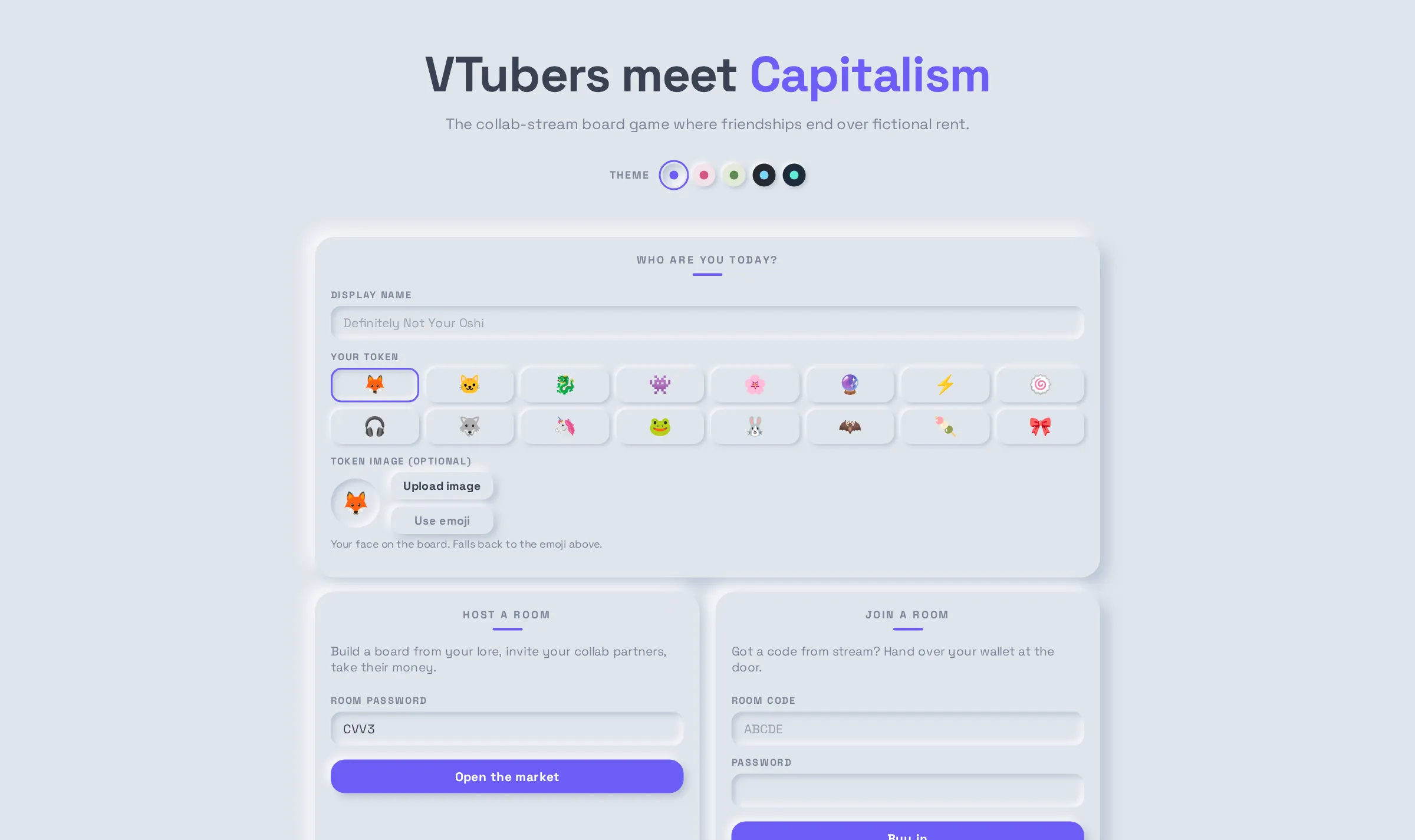
- Tell the game who you are. A display name, an emoji token — or upload a custom token image (your mascot, your chibi, your brand). It rides the board with you all game.
- Host or join. The host clicks Open the market and gets a 5-letter room code plus a password. Everyone else enters both at the door. The Copy invite button in the lobby hands you a shareable blurb for stream chat or Discord.
- Set up the room. In the lobby the host can edit the board (more on that later), toggle house rules, enable team mode, and everyone can trash-talk in the built-in chat. Up to 8 players.
- Take turns. Roll the dice, move, and resolve the tile: buy the property or pass it (hello, auction), pay rent, pay taxes, draw from The Algorithm, or get sent to Shadowban — the game’s jail, escaped by rolling doubles, paying the fine, or serving three turns.
- Doubles roll again. Three doubles in a row is cheating somewhere: straight to Shadowban.
- Win. Last player (or last team) still solvent takes everything. The end screen hands out a broadcast-ready stats card — screenshot it, it’s your trophy.
TIP
Games are mathematically guaranteed to end. Every twelve turns per surviving player, late-stage capitalism kicks in and all rent goes up another ×1 — permanently. Nobody camps forever.
The board#
Forty tiles, arranged like the classic layout, reskinned top to bottom:
| Tile | What it does |
|---|---|
| 22 streets in 8 color sets | Buy them, complete sets for double rent, then develop them (see below). Sets range from Humble Beginnings (Closet Studio, Scuff City) to Legend Tier (Idol Apex, Legend Stage). |
| The Platforms ×4 | The subway-equivalent: The Purple Site, The Red Site, The Green One, The Clock App. Rent scales with how many one player controls (₵25/50/100/200). |
| Essential Services ×2 | The ISP and The Power Company. Rent is the dice roll ×4 — or ×10 if one player owns both. |
| The Algorithm ×3 | The chance deck: viral clips, copyright strikes, senpai raids, crowdfunding. Board creators can write a fully custom deck. |
| Tax & Sponsor tiles | Agency Cut and Tax Season take your money; Sponsor Deal, Ad Read, and Brand Collab pay you. |
| The corners | Debut Day (collect ₵200 for passing), Shadowban Corner, the Break Room (free parking — or a jackpot with the right house rule), and Cancelled! (go directly to Shadowban). |
Owned tiles are unmistakable at a glance: colored ring, tint, owner chip, and a line through the name — important when eight people are screaming over each other.
Building: Emote Slots and the 3D Debut#
Own a complete color set and you can develop it on your turn:
- Emote Slots (levels 1–4) — each costs half the tile’s price and multiplies its rent up the ladder (×5, ×12, ×25, ×40).
- The 3D Debut (level 5) — the hotel equivalent. ×60 base rent and a golden stage card the whole stream will see.
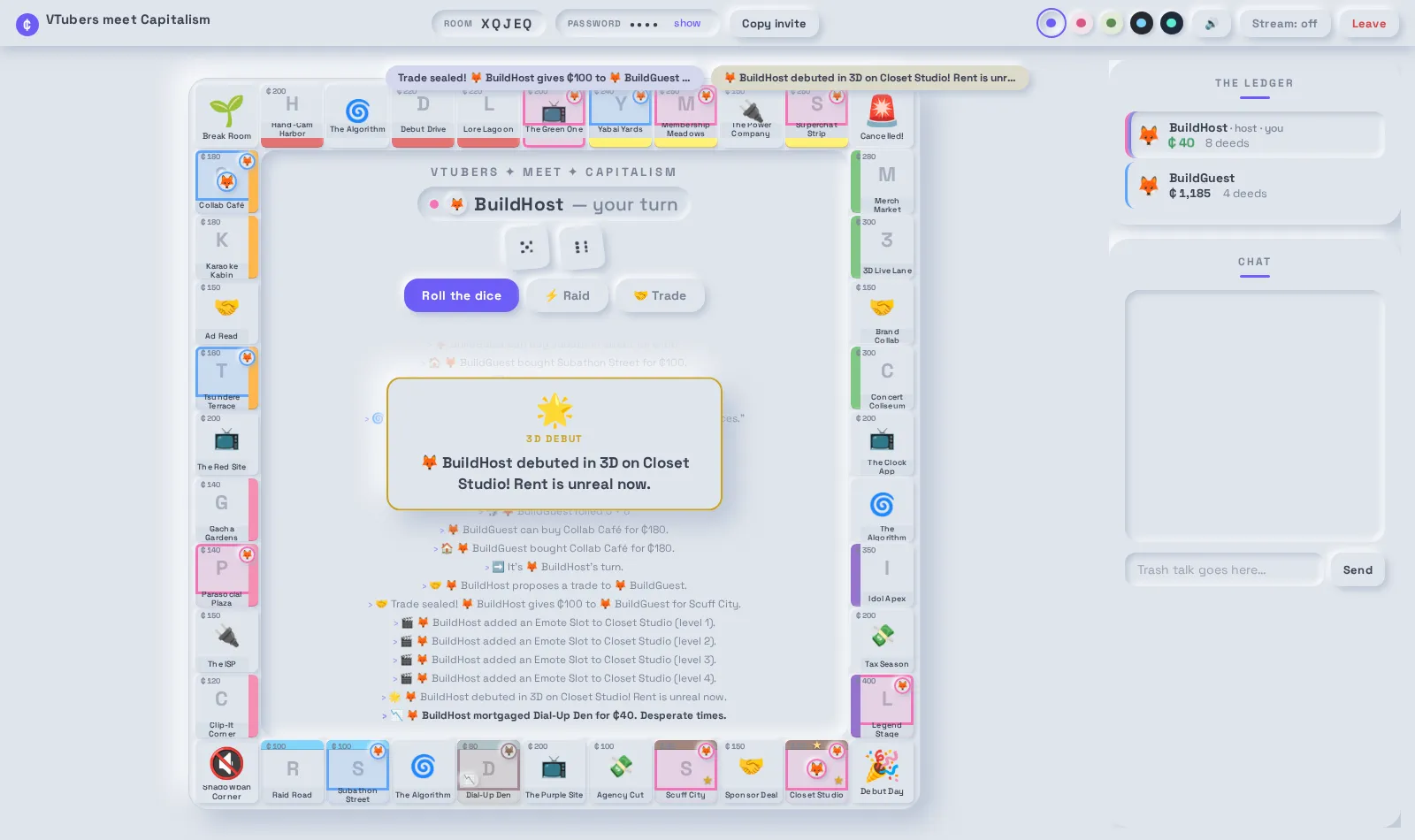
Buildings show as pips on the board tile, so everyone can see the death row forming. Short on cash? Mortgage a tile for half its price (it stops charging rent until you unmortgage at +10%) — but you must sell a set’s buildings before mortgaging any tile in it. And if rent finally bankrupts you, your creditor doesn’t just win: they repossess your entire empire, buildings and all.
Trading#
Any time, any player (as long as no auction is running): open the trade builder, pick a partner, and put together an offer — any mix of tiles and money on both sides, with a live plain-language summary before you send.
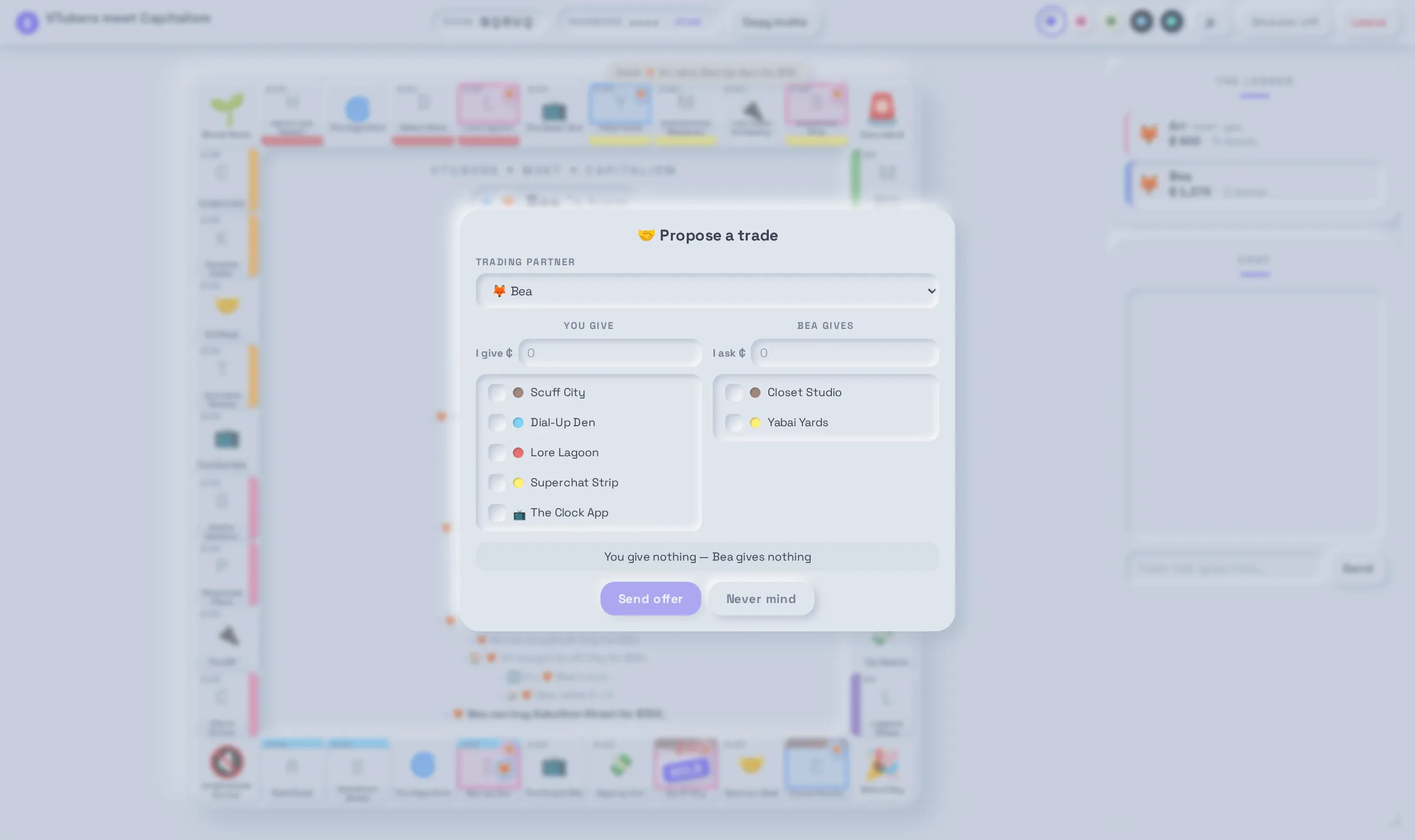
The other player gets a prompt showing exactly what they’d give and receive — accept or decline. Offers re-validate at acceptance time, so nobody can sneak a tile out from under you mid-handshake.
Auctions#
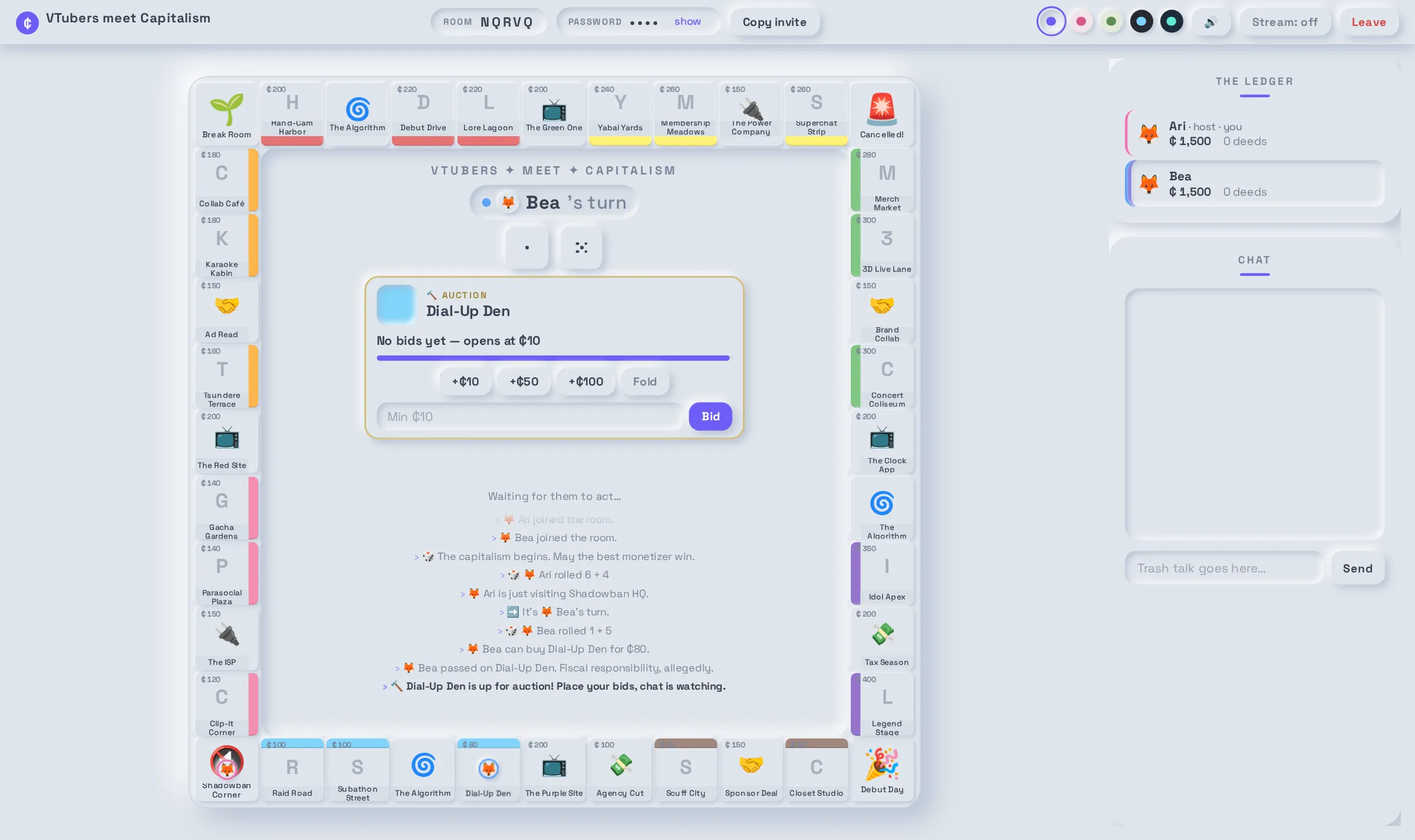
Pass on a purchase and the tile doesn’t just sit there: it goes to a timed open auction with everyone at the table. Quick-bid buttons (+₵10/+₵50/+₵100), custom amounts, and a countdown bar — and any new high bid resets the clock to 10 seconds, so last-second snipes still have to fight.
TIP
Auctions are a house rule (on by default) — the host can switch them off in the lobby for a more classic, slower game.
Raids#
Once per game, before rolling, you can raid another player: the next rent payment they would receive — from anyone — gets yoinked into your pocket instead, with a lightning flash and a stage card announcing the crime to the entire stream. One per player per game, so timing it for a developed street is everything.
Team mode#
For bigger collabs: 2v2 (or 3v3) teams, assigned automatically at start. Teammates pay each other no rent (“genmate discount”), sets can be completed across teammates, either teammate can build on team-held sets, and the last team standing wins together. Needs an even player count; pairings follow join order, so choose your seat next to your oshi wisely.
House rules & the turn timer#
The host can toggle any of these in the lobby — they sync live to everyone and stay visible in-game:
| Rule | Effect |
|---|---|
| Break Room jackpot | All taxes and fines pool into a pot. Landing on the Break Room wins it all. |
| Snake-eyes bonus | Rolling double 1s pays ₵100. Chat clips it instantly. |
| Rebrand immunity | After leaving Shadowban, your next turn is rent-free. The rebrand is working. |
| Auctions (default on) | Declined purchases go to auction. |
| Turn timer (off/30/60/90s) | A visible countdown; running out auto-ends the turn. Keeps six-person collabs moving. |
The end-of-game stats card#
When someone wins, everyone gets the results broadcast: winner spotlight, then superlatives computed from the actual game — Deepest Pockets (most rent collected), Most Brutal Rent (biggest single hit), Luckiest Roller (most doubles), Shadowban Regular, Raid Boss, Big Spender — plus a per-player table of money, deeds, and rent flows.
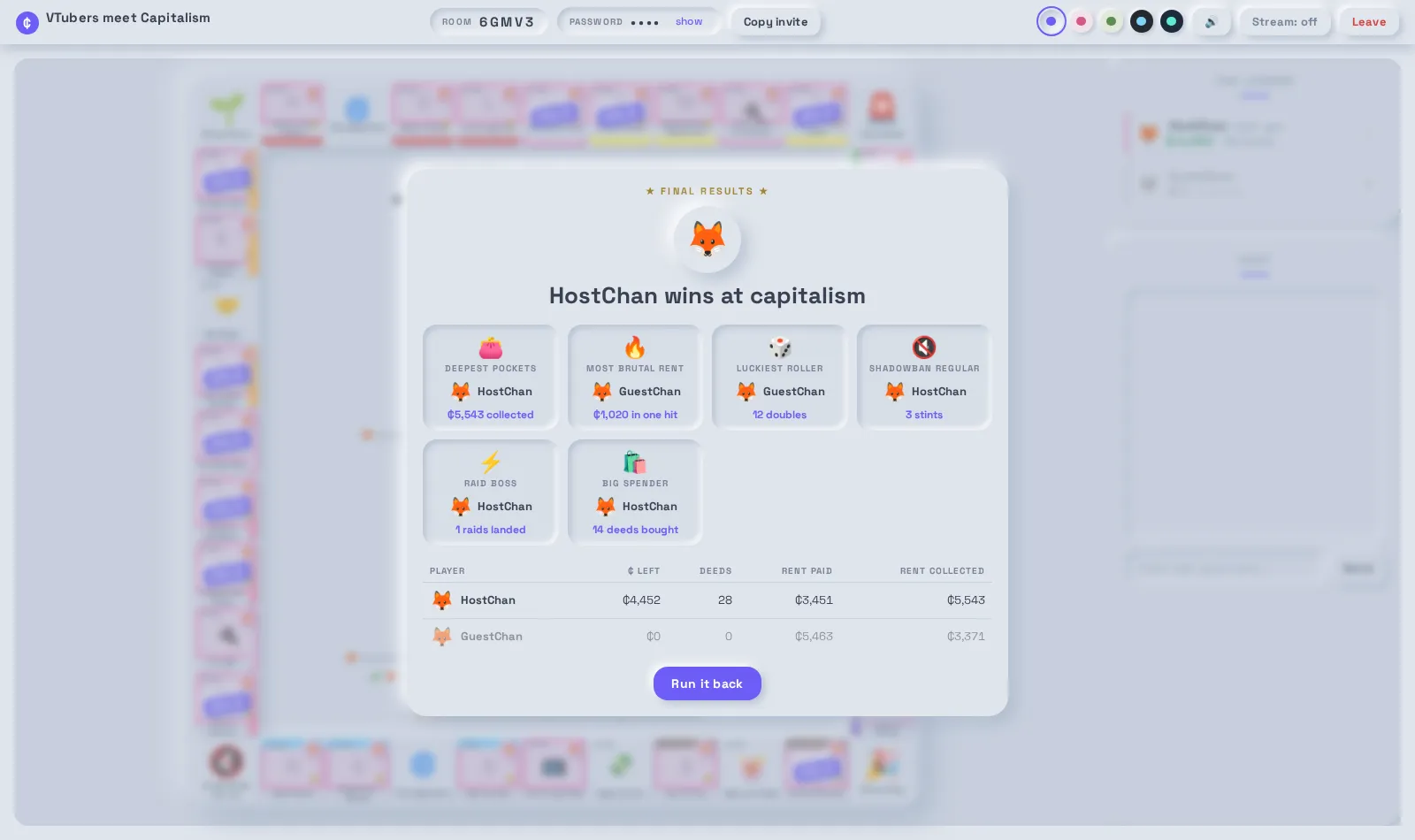
The host can run it back to the lobby for a rematch with the same crowd and board.
Reconnect & resume#
Streams are chaos; internet dies. If you refresh or your tab crashes mid-game, reopen the game and the home screen offers a “Dropped mid-collab?” rejoin card — one click puts you back in your seat, mid-game, same money, same deeds. If the host drops, the room automatically hands hosting to the longest-present player after a grace period — and if the original host rejoins quickly, they resume their duties.
Sound, cinematics, and the little moments#
Synthesized sound effects (no audio files — everything is generated): dice rattle, coin chimes for rent, a metallic clang for Shadowban, a gavel for auctions, a fanfare for the win. A mute toggle lives in the top bar and remembers your choice. On the visual side: slow-mo dice on doubles, screen shake on ₵1000+ rent, a danger pulse on big hits, ghosted tokens for the bankrupt, and entrance animations in the lobby.
Play from your phone#
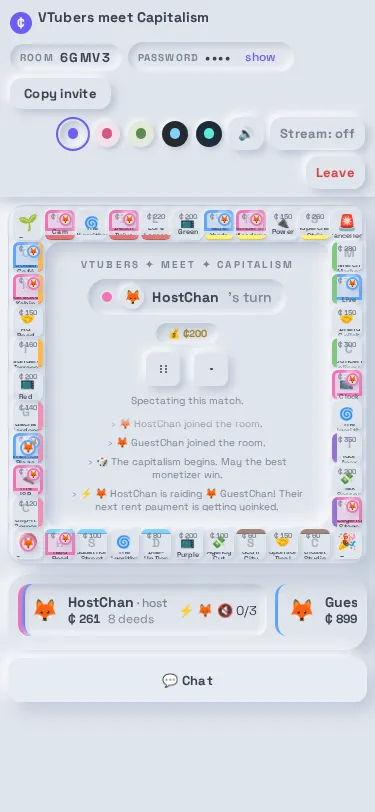
The whole game works at phone width: the board stays square and legible, players collapse into a swipeable chip strip, actions pin to a bottom bar, chat tucks behind a toggle. A collab partner can genuinely play from the McDonald’s parking lot. We don’t judge.
Make it yours: the board editor#
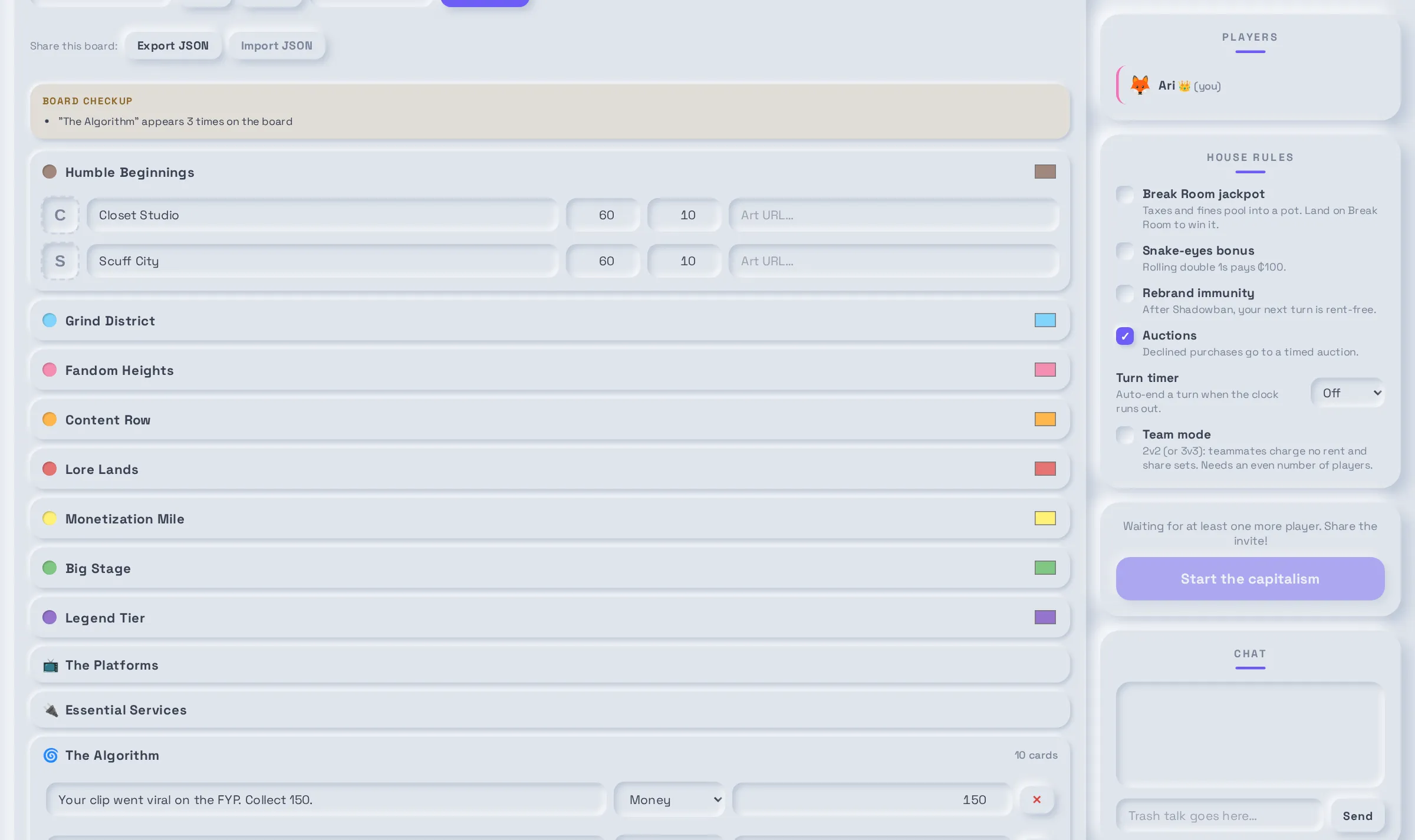
This is the heart of it. In the lobby, the host can rebuild the entire board:
- Rename everything — streets, platforms, services, corners. Set prices, rents, and set colors.
- Add tile art — upload your own images for properties; they’re compressed in-browser so boards stay light.
- Write a custom Algorithm deck — up to 30 cards with your own jokes and lore (“You said the forbidden word on stream. Go directly to Shadowban.”). Card kinds: gain/pay money, move spaces, go to a specific tile, or Shadowban.
- Board checkup — a live lint strip warns about broken rent curves, mixed set colors, duplicate names, and wild card swings before your players find them the hard way.
Sharing boards: pure JSON, no database#
Export JSON downloads the whole board — tiles, art, custom deck, and an auto-generated preview thumbnail — as one file. Import JSON restores it. That’s the entire sharing system, deliberately: boards travel through Discord DMs, Google Drive, community wikis, wherever your community already lives. No accounts, no gallery, no server to shut down. Presets and your last board are remembered locally by your browser.
Five UI themes (from soft mist to full dark) round out customization — pick one in the top bar.
Stream setup: viewers are first-class#
- Latecomers become spectators. Anyone joining after start watches the full game live — board, rolls, effects — without a seat. Perfect for a manager, a guest, or the OBS overlay machine.
- Stream mode (top bar) tightens the layout for capture.
- The hype ticker slides big moments across the top of the screen: set completions, 3D Debuts, raids, jackpots, bankruptcies, auction wins.
- Everything big gets a stage card — center-screen, animated, impossible for chat to miss.
The OBS overlay#
Add the game with ?obs=1 as a browser source (something like 1280×300 or taller) and you get a transparent overlay carrying only the ticker and the stage cards. Join the room from inside the browser source after the game starts so the overlay lands as a spectator, then layer it over your stream layout:

Fine print#
- Rooms are password-protected; share both the code and password only with your collab partners.
- The host’s browser runs the room’s economy; if they leave, hosting migrates automatically. Everyone’s client resyncs from the room state, so brief disconnects heal themselves.
- Money is fake, rent is fictional, but the friendships ended over Legend Stage are forever.
Now go build a board out of your lore, invite your genmates, and find out who among them was a landlord all along. 🔥